
The Attention Wound
What the attention economy extracts and what the body cannot surrender

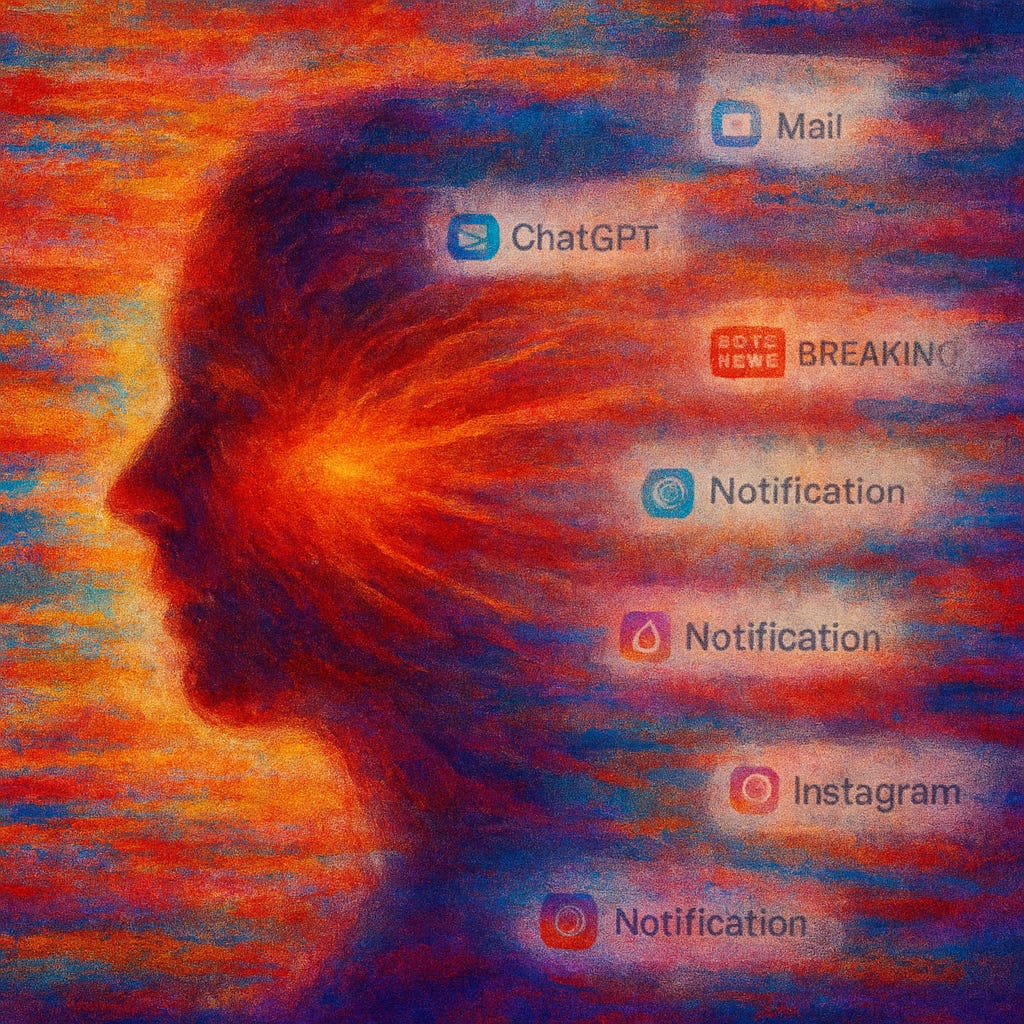
The Scale of What We Take In
Every second, our senses deliver about eleven million bits of information to the brain. We consciously process perhaps forty. The rest gets filtered, suppressed, ignored. This biological limit became the raw material of an industry—one that learned to exploit not just the forty bits we consciously process, but the millions that bypass awareness entirely. The extraction happens below the threshold of choice.
We know the standard critique. Attention commodified, harvested, sold. Smartphones. Social media. Algorithmic feeds. Variable reinforcement. Infinite scroll. Endless notifications. Fractured focus. Shallow discourse. Democracy at risk.
This framing, attention as a resource to be harvested, has become so naturalized we barely notice it. We speak of paying attention as if it were currency, spending time as if it were capital. The metaphors reveal the colonization, but obscure something crucial.
Attention is not a resource. It is a relationship, and it begins in the body.
The Attention Economy as a Trauma System
What we have not yet named clearly is this: the attention economy is a mass traumatization system. Not metaphorically. Neurobiologically. It induces the same defensive narrowing that trauma induces, but at population scale. The events differ in magnitude, but the defensive architecture is the same: constriction, narrowing, the collapse of presence. The body learns to leave itself.
The Parallel in the Therapy Room
In the therapy room, I see what happens when the nervous system has learned that experience is dangerous. Breath climbs into the chest. Eyes dart. Shoulders tighten. Awareness collapses to a pinhole. The body constricts around what feels survivable.
This response is adaptive. Trauma teaches the nervous system that some experiences cannot be tolerated, so it limits exposure. The constriction brings temporary relief. It can also create long-term costs: loss of sensation, loss of connection, and the erosion of the ability to stay present with difficulty.
Now consider the attention environment we inhabit. Variable reinforcement trains the orienting reflex into constant alert. Notifications trigger micro-shocks dozens of times a day. Infinite scroll exploits our difficulty disengaging from incomplete cycles. Every design choice optimizes for shallow, narrow, brief engagement. Transitory. Involuntary. Capturable.
Both environments overload the system. Both produce constriction. Both shrink the window of tolerance, the range of experience the nervous system can handle without shutting down. The body learns that presence itself is unsafe.
For those of us whose nervous systems formed before the smartphone, this is deterioration. For those born into the extraction apparatus, there is no before. What becomes baseline is an environment that keeps the nervous system braced, not settled. For them, expansion is not recovery. It is the work of developing what was always there but never had room to grow.
Why Current Solutions Fail
The dominant responses fall into two camps.
One says the solution is discipline: digital detox, screen limits, willpower.
The other says the solution is structural: regulation, antitrust, algorithmic transparency.
Both matter. Neither addresses the body.
Digital detox is willpower applied to a nervous system problem. You cannot force yourself out of a trauma response. When willpower drains, the behavior snaps back.
Legislation addresses supply but not demand. Even if every predatory design practice vanished tomorrow, we would still inhabit bodies shaped by years of chronic overstimulation. Capacity does not return automatically. It must be rebuilt.
What is missing is somatic capacity: the nervous system’s ability to tolerate experience without constricting. This is not a cognitive skill. It is a physiological state.
You cannot legislate your way to resonance. You cannot detox your way to depth.
The ability to stay present with difficulty must be cultivated in the tissue.
The Tactical Reversal
When attention feels threatened, the instinct is to protect it. Guard your focus. Build boundaries. Construct walls.
But protection replicates the problem. Walls tighten the field. Constriction is still constriction.
The counterintuitive truth: the antidote to narrowing is expansion. Not protection. Not avoidance. Expansion under conditions that once triggered collapse.
A narrow window of tolerance means almost anything can overwhelm. A wider window makes the same stimuli tolerable. You do not need to control the environment if the body can hold more.
Width, Depth, Duration
The work involves three dimensions.
Width is spreading sensation across more of the body. Overwhelm often lodges sensation in one tight location: throat, chest, gut. The practice is to notice where the intensity is and let awareness include adjacent territory. The ribs. The back. The lower body. Spread out, sensation becomes tolerable.
Depth is the shift from surface tension to grounded presence. Shallow attention corresponds to shallow breath and shallow feeling. Depth is not intensity. It is allowing experience to settle.
Duration is staying with difficulty longer than the nervous system predicts is possible. Trauma teaches that certain sensations must be escaped immediately. Staying without collapsing rewrites those predictions. Each moment becomes new evidence that presence is survivable.
These are not relaxation techniques. They are methods for expanding the physiological capacity required for sustained attention.
The Practice
When you feel the impulse to check your phone or scroll, pause. Not by clenching or holding your breath, but by noticing what the urge feels like in the body. Where does the pull live? Chest? Face? Fingers?
Then widen. Include more of your body. The weight of your legs. The contact beneath you. The air on your skin. You are expanding the field, not distracting yourself.
Stay. Not forever. Just a little longer than is comfortable. Let the cycle crest and fall without acting on it. This is the nervous system learning safety.
And if you still reach for it? Fine. The point is not to never check. The point is to interrupt the reflex. Noticing before acting, even for a few seconds, restores choice. The capture was automatic. The response no longer is. And whatever you find there, you meet it from a wider base.
This is not about productivity. It is about capacity.
From Body to Body Politic
The personal is physiological. And the physiological is political.
The capacity to imagine otherwise depends on the capacity to remain present with difficulty. When attention collapses into shallow, reactive cycles, possibility collapses with it. You cannot build or protect a democracy from a nervous system locked in survival mode.
And the extraction keeps deepening. We now pour our thoughts, our questions, our inner voice into AI systems that learn us and sell the patterns back. Attention was the surface. Interiority is the new frontier.
But something deeper is happening. We are outsourcing the work bodies do. Technology can extend human capacity—tools that help us think, remember, imagine. What we have now is not extension. It is replacement.
AI can extend our reasoning—when used as a tool for iterative thought, where the human remains the locus of judgment and choice. But the dominant use substitutes for reasoning. Social media can extend our relationships—but more often it simulates connection without co-regulation. The output looks similar. The effect on the organism is opposite.
The question is not the technology. It is whether capacity expands or atrophies through use.
The Political Stakes
When the body loses its capacity for presence, systems lose their capacity for possibility. The same reflexes that shape our inner landscape begin to shape our public one.
We engineer machines to capture carbon while forests already breathe for free. We build data centers that consume cities’ worth of electricity to reproduce what the nervous system already knows how to do, if we let it.
What was free now has a price. What was embodied becomes a subscription.
And the replacement is always worse than what it displaced.
The attention economy leaves us physically alone and digitally bound. No co-regulation. No grounding. Just bodies in isolation and nervous systems wired into a system built to extract.
There is just enough signal to engage us, but not enough co-regulation to settle the system. We stay hungry. We keep scrolling.
And the effects cascade across generations. Children raised by chronically distracted adults inherit dysregulation before they inherit language. We hand them screens—and increasingly, chatbots—as stand-ins for the presence we ourselves struggle to sustain.
Narrowing begets narrowing. Brand identity works through eliminating alternatives. So do political regimes. Control the attention and you control the frame. Control the frame and you control what is possible to imagine.
A population trained into chronic attentional constriction is a population primed for authoritarianism. Not because of ideology but because of physiology. Narrow focus. Short time horizons. High reactivity. Reduced tolerance for ambiguity. These are the somatic preconditions for surrendering agency.
Before a society loses the ability to resist, it loses the ability to stay.
What Cannot Be Scraped
The body’s capacity to feel and stay cannot be scraped. It is the one site extraction cannot fully reach, and the ground on which political possibility depends.
A nervous system that can widen, settle, and remain present disrupts the entire logic of capture. Presence breaks the spell. Capacity interrupts extraction at its root.
Collective Presence
Everything that is true of an individual nervous system is true of a collective one. We regulate through each other. We calibrate our internal states through faces, voices, breath. A regulated body steadies the bodies around it. A braced one spreads tension.
When bodies gather in shared space with shared focus, the room becomes a container. A silent audience. A crowd in rhythm. An unhurried meal. These are not nostalgic luxuries. They are regulatory environments.
Isolated attention is capturable attention. Collective attention is not. It is anchored in bodies, in rooms, in relationships that cannot be mediated or monetized. A society capable of shared presence is harder to manipulate.
Reclamation
The way forward is not fortification. Walls mirror the trauma response. The work is reclamation: attention restored to its original function as relationship, not currency.
The body knows how to do this. Before language, the infant gazes at a caregiver’s face and enters resonance. That capacity never disappears. It constricts under overwhelm. It returns through expansion.
The body’s capacity to feel and stay is the one resource that cannot be extracted. And it is the prerequisite for attention, imagination, political agency.
What we can feel, we can attend to.
What we can attend to, we can stay with.
What we can stay with, we can imagine beyond.
This sequence is not metaphor. It is the architecture of the nervous system.
Our task is to expand until capture becomes impossible.
Presence is the prerequisite.
Expansion is the method.
Resonance is the goal.
Note on Influences
Tim Wu, The Attention Merchants — Wu traces the history of attention as commodity from the penny press through propaganda, broadcasting, and into the digital age. His central insight: the business model that treats human attention as raw material to be harvested and resold has shaped not just advertising but the architecture of modern life. He documents the recurring cycle of attention capture, public backlash, and industry adaptation, each wave pushing commercial interests deeper into private space.
Hartmut Rosa, Resonance — The German sociologist argues that the quality of human life depends not on resources accumulated but on the quality of our relationship to the world. Resonance, his term for the vibrating, responsive connection between self and world, stands opposed to alienation, which he frames as the muting of these relational axes. Rosa locates the source of modern pathology in “dynamic stabilization,” the structural requirement that capitalist societies must continuously accelerate and expand merely to maintain themselves.
Raja Selvam, The Practice of Embodying Emotions — A somatic psychologist, Selvam synthesizes body psychotherapy traditions with contemporary neuroscience. His core contribution: emotional tolerance increases when we can expand emotional experience across more of the body rather than constricting it into narrow regions. Width, depth, and duration become the clinical variables. The work bridges Polyvagal Theory, Somatic Experiencing, and developmental psychology into a coherent framework for embodied emotional processing.
Christine Rosen, The Extinction of Experience — Rosen examines how digital mediation systematically replaces direct, embodied experience with vicarious, virtual substitutes. Drawing on philosophy, cultural criticism, and social science, she argues that we are losing not just attention but the capacity for genuine presence. The book is a humanist’s lament and warning about the consequences of disembodiment.
Ruha Benjamin, Imagination: A Manifesto — Benjamin, a sociologist of science and technology, reframes imagination as political terrain. Whose dreams get resourced? Whose futures get built? She traces how dominant imaginaries colonize possibility itself, while marginalized communities have always cultivated liberatory imagination as survival practice. The book insists that the capacity to envision otherwise must be democratized and defended.
Annie Murphy Paul, The Extended Mind. Paul synthesizes cognitive science showing that thinking extends beyond the brain into the body, physical space, and other people. Her framework draws a crucial distinction: some tools extend cognition, augmenting capacity while the core remains intact; others replace it, simulating the output as the underlying ability atrophies. A notebook extends memory. It does not replace the ability to think. The question for any technology becomes: does using it leave us more capable or less? This essay applies that test to the attention economy and finds mostly replacement, not extension. These systems substitute for reasoning, simulate connection without co-regulation, and hollow out the capacities they mimic. Many people now turn to AI with questions that have no factual answer—not for information, but for reassurance. The chatbot offers something to do other than stay with difficulty. That is replacement at its most intimate: not thinking outsourced, but feeling bypassed.
Oh, the irony of mindlessly scrolling only to find this gem reminding me that it's time to put the phone down, breathe, and head outside. As usual this completely resonates and I love how you distill these concepts. The idea that we are outsourcing what our nervous systems are supposed to do to AI and algorithms reminded me of The Matrix.
I really like this post Stephen, I came back to it a couple of times.
The shift from framing attention as a 'resource' (currency to be spent) to a 'relationship' (a somatic state) is a profound reorientation. I’ve often felt the failure of 'digital detoxes' precisely because they rely on willpower, which I think of as a a cognitive resource, to solve a physiological dysregulation. Your point that 'protection replicates the problem' is a revelation. I never realized that by building walls against the noise, I was still practicing constriction. The idea of expansion as the antidote, widening the container rather than shutting the gates, feels like the missing piece of the puzzle.
The connection you draw between the individual nervous system and the body politic is terrifyingly lucid. We discuss polarization as an ideological issue, but framing it as a physiological one, 'a population primed for authoritarianism' due to chronic constriction, explains why logic and debate seem to be failing us. If we cannot hold space for difficult sensations in our own bodies, we certainly cannot hold space for nuance in the public square. The argument that 'presence is a prerequisite for political agency' should be required reading for anyone trying to understand the current democratic landscape.
Also, thank you for naming the sensation of the 'defensive narrowing'; simply identifying it as a trauma response makes it feel manageable rather than like a moral failing. Excellent post with lots to think about!